


The Real Story of Hantavirus : A Tale of Quick Science, Not a Local Outbreak
- Karen Scheepers

- May 11
- 2 min read
The recent detection of Hantavirus on South African soil serves as a powerful testament to the country's world-class medical surveillance and diagnostic capabilities. Rather than signaling a looming public health crisis, this discovery highlights a "best-case scenario" for modern epidemiology: a rare, imported pathogen was identified, isolated, and contained before it could ever pose a significant threat to the general population.
This level of precision, identifying a specific, non-endemic virus within 24 hours of a patient's arrival, demonstrates the robust "safety net" provided by the National Institute for Communicable Diseases (NICD) and local health authorities. By catching the virus at the gates, South Africa has turned what could have been a silent spread into a controlled medical event, proving that our systems are primed to protect the public from global health threats with clinical efficiency.
How did it get here?
The virus arrived via an international cruise ship, the MV Hondius, which was traveling from South America.
The Travel Route: The ship stopped at various islands (like St. Helena and Ascension) before passengers headed home.
The Cases: Two primary cases were identified in South Africa, both were tourists from the ship. One tragically passed away after collapsing at OR Tambo International Airport, and another (a British national) is being treated in stable condition in a Johannesburg hospital.
Is it spreading in South Africa?
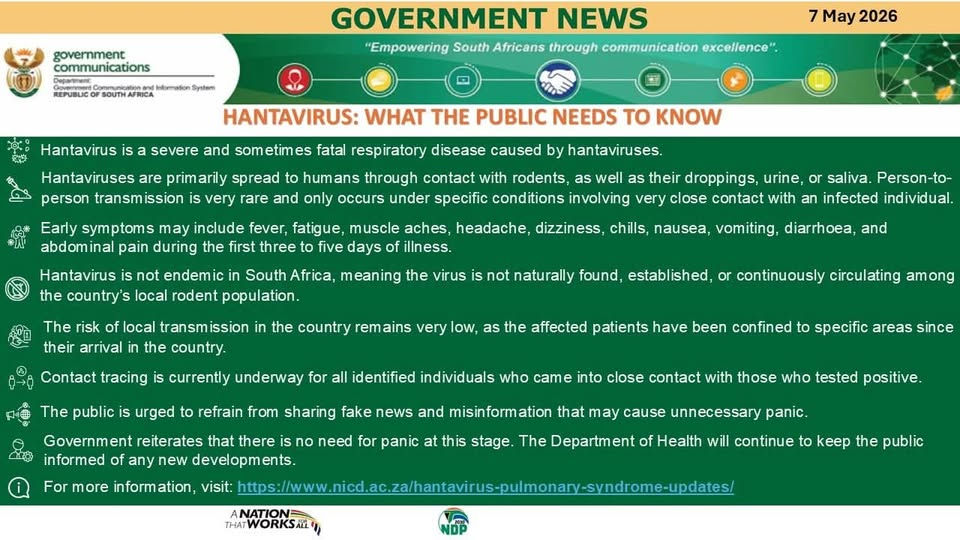
No. The most important fact to know is that Hantavirus is NOT endemic to South Africa. * Our local rodents do not carry this virus.
The cases we have seen were "imported" by travelers who were exposed elsewhere (specifically the Andes strain from South America).
Because the virus is not in our local animal population, there is no ongoing "source" for a local outbreak.
Why You Shouldn’t Panic
While the word "virus" can be scary, the risk to the average South African is extremely low for several reasons:
Rare Transmission: Unlike COVID-19, Hantavirus does not spread easily through the air or casual contact. It typically requires very close, prolonged contact with an infected person or direct contact with infected South American rodents.
Swift Containment: The National Institute for Communicable Diseases (NICD) identified the virus within 24 hours, a "needle in a haystack" achievement.
Contact Tracing: Health officials have already traced and are monitoring nearly 100 people (including flight passengers and healthcare workers) to ensure the chain is broken. As of now, the World Health Organization (WHO) assesses the global risk as low.
What You Need to Know
The Symptoms
In the rare event of exposure, the "prodrome" (early) phase includes:
Fever and chills
Severe muscle aches and fatigue
Headache, dizziness, and abdominal pain
The Golden Rule: Trust Legitimate Sources
Fake news often spreads faster than any virus. To stay truly informed and avoid unnecessary anxiety, only follow these official channels:
The NICD: www.nicd.ac.za
Department of Health: Official social media and websites.
Government News (SAnews): www.sanews.gov.za
Bottom Line:
South Africa’s health systems caught this early and have contained the individuals involved. There is no need to change your daily routine or worry about an outbreak in your neighborhood. Stay calm, stay informed, and ignore the "wildfire" of social media rumors.
🛡️🦠📉📢


Comments