


New Rules for Workers in South Africa: A Simple Guide to the 2026 Earnings Threshold

Starting 1 May 2026, there is a big change coming for employees in South Africa. The government has increased the "Earnings Threshold", the specific amount of money that acts as a dividing line for your legal rights at work.
If you earn less than this amount, the law automatically gives you a lot of protections (like guaranteed overtime pay). If you earn more than this amount, your rights regarding working hours and extra pay are decided by your contract rather than by the law.
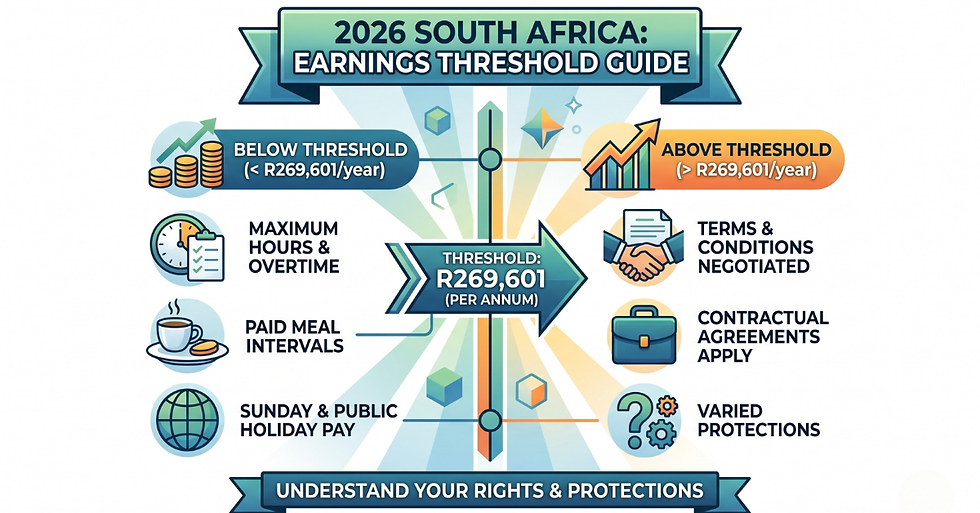
1. What is the New Amount?
The new threshold is R269,600.90 per year. To check your payslip, here is what that looks like :
Monthly: About R22,466.74
Weekly: About R5,184.63
2. How Do I Calculate My "Earnings"?
"Earnings" is not your total "Cost to Company" (CTC) package. It is your gross pay before tax and other deductions are taken out.
What counts toward the threshold:
Your basic salary.
Money taken out for your income tax (PAYE), pension contributions, and medical aid.
What does NOT count (ignore these when checking your status):
Employer Contributions: The extra money your boss pays into your medical aid or pension fund for you.
Allowances: Money for transport, car allowances, or food.
Extra Pay: Bonuses, "achievement awards," or any overtime pay.
3. Benefits of Earning Below the Threshold
If you earn below the R269,600.90 limit, you are automatically entitled to the following protections under the Basic Conditions of Employment Act (BCEA) :
Working Right | Your Legal Entitlement (Below Threshold) |
Working Hours | You cannot be forced to work more than 45 ordinary hours a week. |
Overtime Pay | You must be paid 1.5 times your normal rate (or get paid time off). |
Lunch/Meal Breaks | You must have a 60-minute break after every 5 hours of work. |
Rest Periods | You must have a 12-hour rest between shifts and 36 hours off every week. |
Sunday Pay | You must be paid double (or 1.5x if it is a normal shift day). |
Night Work | You must get an allowance, and the boss must ensure transport is available. |
Public Holidays | You get double pay if you work on a public holiday. |
4. What Does it Mean if You are Above the Threshold?
If you earn more than R269,600.90 per year, the automatic "floor" of protections listed above no longer applies to you.
Contract is King: Your specific working hours, overtime rates, and Sunday pay are now matters of negotiation between you and your employer. If your contract says you don't get paid for overtime, then you aren't legally entitled to demand it under the BCEA.
Reasonable Hours: Even if you are above the threshold, your boss cannot force you to work hours that would damage your health or safety.
Legal Procedures: If you have a dispute about money or discrimination, you cannot use the "free and fast" CCMA arbitration process to get a final decision. Instead, you usually have to take your case to the Labour Court, which involves higher costs and hiring lawyers.
Senior Managers: If you are a "Senior Manager" (meaning you can hire, fire, and represent the company), most of these rules do not apply to you even if you earn less than the threshold.
5. Summary: What You Should Do Now
Do the Math: Check your gross salary (excluding your boss's pension/medical contributions) to see if you fall below the R22,466.74 monthly limit.
Read Your Contract: If you are above the limit, ensure your contract clearly states how you will be compensated for extra work.
Know Your Rights: Remember that rules for annual leave and sick leave do not change based on this threshold, everyone is entitled to those.
6.National Minimum Wage
In addition to the earnings threshold changes, the national minimum wage in South Africa increased to R30.23 per hour, effective from 1 March 2026. This standard rate applies to almost all employees across all sectors, including farm workers and domestic workers.
However, there are specific exceptions: workers employed on expanded public works programs are entitled to a lower rate of R16.62 per hour, and separate rates are established for workers under learnership agreements.
Employers are legally required to ensure that their pay structures meet these minimums, as non-compliance can lead to significant administrative fines, typically starting at twice the value of the underpayment.
Final thought
This change is designed to ensure that as the cost of living goes up, workers' protections stay relevant. Whether you fall above or below this new R269,601 line, the most important step is to understand your specific status.
For those now newly protected, it is a chance to ensure fair pay for overtime; for those above the threshold, it is a reminder to ensure your employment contract is clear and fair. Stay informed to ensure your rights are always protected in the South African workplace. Disclaimer: This information is provided for informational purposes only and does not constitute formal legal advice. Because the changes to the earnings threshold and employment legislation involve complex compliance obligations and emerging workplace risks, it is recommended that you consult a qualified labour law practitioner for specific legal guidance regarding your unique employment practices or protected disclosures.
🇿🇦 💼 ⚖️ 📈


I would like to sincerely recommend NaturePath Herbal Clinic based on my personal experience.
I was diagnosed with Amyotrophic Lateral Sclerosis four years ago. Despite following prescribed treatments for over two years, my condition gradually became more difficult to manage. I experienced increasing muscle weakness, fatigue, and challenges with everyday activities.
Seeking additional support, I decided to try the herbal program from NaturePath Herbal Clinic. Although I was initially skeptical, I began to notice positive changes within a few months. My energy levels improved, I felt more comfortable physically, and I was better able to manage daily tasks.
This experience has made a meaningful difference in my overall well-being, and I truly appreciate the support I received throughout the process.