


Triumph and Tenacity: Fochville Water Flows Again

The communities of Kokosi, Fochville, and Greenspark have experienced a moment of profound relief and triumph as water, after "long, painful months of suffering," finally began flowing in their taps on 11 December 2025. This victory, heralded by the Greater Fochville Water Crisis Committee, symbolises not just the return of a basic necessity, but the power of community resilience in the face of a severe, "man-made crisis."
However, this local celebration of hope is juxtaposed against the broader, critical issues of systemic infrastructure decay, municipal debt, and ongoing water supply challenges plaguing the entire region, as highlighted by investigations from the South African Human Rights Commission (SAHRC) and responses from Rand Water.

A Community's Unbreakable Spirit
The Greater Fochville Water Crisis Committee framed the return of water as a profound victory for the community's spirit. Their statement emotionally recounts the hardships endured, noting the desperation of "mothers, fathers, sisters, and children risking everything, fetching water from rivers, stormwater drains, and unsafe sources, just to survive."
The Committee expressed "joy and gratitude," thanking the community for their "courage, bravery, and perseverance". They stressed that the return of water is "not just about water; it’s about hope, resilience, and the unbreakable spirit of us all," and declared that the collective fight "was not in vain," urging the community to view this moment as the "beginning of a new chapter" where clean, safe water is guaranteed.
Despite this success, a subsequent update from the Merafong City Local Municipality indicated that the full restoration of supply was being delayed in other parts of Fochville, Kokosi, and Greenspark due to the theft of a valve. The municipality confirmed that it is actively working to replace the stolen component to resolve the situation quickly.
The SAHRC Intervention and Systemic Decay
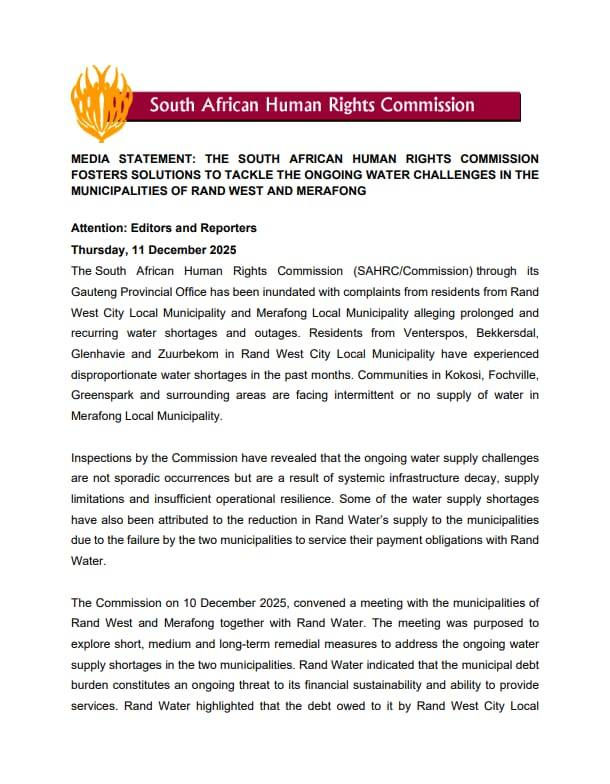
The severity of the water crisis across the region, encompassing both Rand West City Local Municipality and Merafong Local Municipality, prompted an urgent intervention from the South African Human Rights Commission (SAHRC).
On 11 December 2025, the SAHRC issued a media statement confirming it had been inundated with complaints regarding "prolonged and recurring water shortages and outages." Residents in areas like Venterspos, Bekkersdal, Glenhavie, and Zuurbekom (in Rand West City), as well as Kokosi, Fochville, Greenspark, and surrounding areas (in Merafong), were noted to be facing "disproportionate water shortages" or "intermittent or no supply of water."
Crucially, the Commission's inspections revealed that the ongoing challenges were not merely "sporadic occurrences" but a direct result of "systemic infrastructure decay, supply limitations and insufficient operational resilience."
The SAHRC further attributed the reduction in Rand Water's supply to the municipalities to their "failure... to service their payment obligations with Rand Water." This financial failure led Rand Water to impose water restrictions as a measure of credit control, reducing supply to Merafong Local Municipality by 40% and Rand West City Local Municipality by 20%. The debt owed to Rand Water was significant, with Rand West City owing about R964 million and Merafong Local Municipality owing over R1.5 billion.

Multi-Stakeholder Commitment to Remedial Action
In response to the crisis, the SAHRC convened a meeting on 10 December 2025 with the municipalities of Rand West and Merafong, along with Rand Water, to explore "short, medium and long-term remedial measures." Rand Water explicitly stated that the municipal debt burden poses an "ongoing threat to its financial sustainability and ability to provide services."
The meeting concluded with resolutions for all parties to address the situation.

Rand Water Commitments
Rand Water committed to several measures aimed at securing repayment and restoring supply:
Acceptance of Merafong’s Repayment Plan: Rand Water formally and unambiguously accepted Merafong Local Municipality’s revised repayment proposal for its current account, interest accruals, and historic debt. This plan, submitted after a meeting on 2 December 2025, was acknowledged as a structured plan that deals "comprehensively" with both current and historic debt.
Merafong’s Short-term Payments: For the November and December 2025 invoices, Rand Water recorded and accepted Merafong’s commitment to making a payment of R20 million for each invoice, with the December payment due no later than 31 January 2026.
Repayment Structure: The plan includes monthly payments in full from February 2026 onwards and a five-year repayment programme for the historic debt commencing 1 July 2026.
Suspension of Charges: Rand Water proposed finalising and signing a Debt Settlement Agreement (DSA) during December 2025, which would allow Rand Water to suspend charging interest on anticipated current account shortfalls for December 2025 and January 2026.
Rand West City Proposals: Rand Water committed to considering Rand West City’s proposals regarding the liquidation of its R74 million current account debt and, if satisfied, entering a revised DSA and uplifting water restrictions.
Reporting and Collaboration: Rand Water is required to report back to the SAHRC by 12 December 2025 regarding the outcomes of the Rand West City proposals and the conclusion of the DSA. Both Rand Water and the municipalities agreed to continue discussions on establishing a Special Purpose Vehicle (SPV) and conducting joint campaigns for public awareness.


Municipal Commitments
The municipalities outlined specific actions to tackle the water crisis:
Merafong Local Municipality:
Implement the revised DSA entered into with Rand Water.
Continue communication to alert residents of supply disruptions.
Finalise discussions with Rand Water on the establishment of an SPV.
Implement interventions to enhance revenue collection.
Rand West City Local Municipality:
Continue with communication to alert residents of supply disruptions.
Provide a proposal to Rand Water on liquidating the R74 million current account debt.
Ring-fence revenue generated from water supply.
Expedite revenue enhancement strategies for improved water revenue.
Immediately commence measures to tackle high water distribution losses, currently at 51%.
SAHRC Commitments
The SAHRC committed to:
Continue monitoring the situation to ensure water supply is restored to normal in both municipalities.
Institute accountability mechanisms to ensure all parties adhere to their commitments.
The SAHRC strongly emphasised that the water challenges have a "detrimental and direct impact on several rights, such as health, education and dignity," and stressed that the crisis will only be resolved through "synergy, coordinated action, shared practical solutions and accountability."

The Role of Citizen Payments in Sustained Supply
An essential element in resolving this crisis is the public's financial contribution. Rand Water's own public service campaign, "PAY THE BASICS FIRST," underscores that "YOUR PAYMENT KEEPS WATER FLOWING." The campaign stresses that "Every rand paid towards your municipal account goes further than you think," strengthening infrastructure, keeping services stable, and building a healthier community. The clear message is for residents to "PAY YOUR MUNICIPALITY, SO IT CAN PAY RAND WATER." This highlights the ultimate dependence of the utility on the timely revenue collection of the municipalities and, by extension, the payment behaviour of the end-user.
Securing the Right to Water and Dignity
The moment of water returning to the taps in Kokosi, Fochville, and Greenspark is a cause for celebration, a tangible sign that collective effort and high-level intervention can yield immediate results. However, the comprehensive documents from Rand Water and the SAHRC reveal the deep-seated systemic failures, infrastructure decay, massive debt, and poor revenue management, that threaten the long-term right to water for hundreds of thousands of residents.
The focus now shifts from immediate relief to sustained accountability and the rigorous implementation of the agreed-upon DSAs and revenue enhancement strategies, ensuring that the dignity and human rights of affected residents are permanently restored and upheld.
🌊⚖️🇿🇦✊


Comments