


Echoes of the Oude Begraafplaats: The Living History of Alexandra Park

In the quiet corners of Potchefstroom, where the grass grows long and the shadows of ancient trees stretch across weathered stone, lies a sanctuary that bridges two centuries of South African triumph and tragedy. Alexandra Park, known to historians as the "Old Cemetery" or Oude Begraafplaats, is far more than a collection of graves; it is a sprawling open-air archive of the Transvaal’s earliest days. Established in 1840, just two years after the town itself was founded, this sacred ground serves as the final resting place for the architects of a republic, the victims of a brutal war, and the pioneers who brought the first printed words to the interior.

A Heritage in the Long Grass
Today, the park reflects the complex reality of South African heritage preservation in the 21st century. Visitors arriving at the entrance are met with a scene that is both haunting and evocative: vast stretches of unmanicured grass and weeds often obscure the smaller markers, a stark departure from the manicured rose beds of its 1903 namesake. Cracks snake through the boundary walls, and many of the original slate headstones have succumbed to the elements, their inscriptions flaking away into the soil.
Yet, this "wild" state also highlights the urgent, dedicated work of organizations like Heritage Potch. While the municipality struggles with the immense task of maintaining such a large historic site, the park remains open to those who know its secrets, a place where the history isn't just displayed, but is actively being reclaimed from the earth. The current condition serves as a powerful metaphor for memory itself: if not actively tended, even the greatest stories can be swallowed by time.
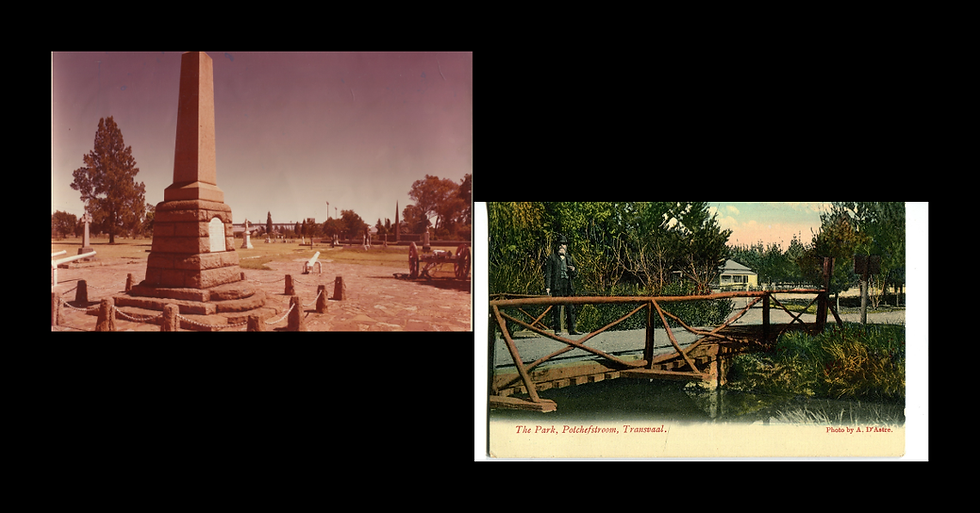
A Republic’s Architect: The Legacy of M.W. Pretorius
At the heart of the park stands one of Potchefstroom’s most significant landmarks: the tomb of Marthinus Wessel Pretorius. As the first President of the South African Republic (ZAR) and the man who founded Pretoria, his influence on the geopolitical landscape of the region cannot be overstated.

The monument seen today, a towering sandstone obelisk, was not part of the original 1840 layout. It was unveiled in 1913 by General Louis Botha, the first Prime Minister of the Union of South Africa. The ceremony was a poignant moment of national reconciliation, facilitated by Pretorius’s grandson, Izak Meyer. Walking through the park today, the monument serves as a North Star for visitors, a reminder of the era when Potchefstroom was the capital of the Transvaal and the center of Boer political life.

From Sacred Ground to Edwardian Elegance
By the turn of the 20th century, the cemetery had begun to take on a dual identity. In 1903, it was formally named Alexandra Park, in honor of Queen Alexandra, the wife of King Edward VII. This period saw the site transition from a somber burial ground into a curated public space.
Historical photographs from 1909 capture a striking contrast: the band of the 9th Lancers performing during St. George’s Day celebrations. Under large canvas tents, Victorian and Edwardian residents gathered for festival services, surrounded by rose beds and manicured paths. It was a place where the living and the dead coexisted, a park for Sunday strolls that just happened to hold the bones of the town’s founders.

The Shadow of the Anglo-Boer War
The peaceful park-like atmosphere of the early 1900s was a necessary veil over the immense tragedy that had occurred just years prior. During the Anglo-Boer War (1899–1902), the cemetery reached its capacity with devastating speed.

The British concentration camp, located nearby on the site of what is now Potchefstroom Boys High, saw a high mortality rate among Boer women and children. Simultaneously, British soldiers were succumbing to both the wounds of battle and the ravages of enteric fever. The park contains a dedicated section for these British "fallen," including Private H. Thomas of the 2nd South Wales Borderers, killed in action at Modderfontein in 1901. His headstone, erected by "comrades of all ranks," stands as a testament to the military brotherhood that persisted even in a foreign land.

Pioneers of the Press and Pulpit
Beyond the military and political giants, Alexandra Park preserves the memories of those who built the cultural fabric of the Transvaal. Among the weathered stones is the grave of J.P. Borrius, a Dutch immigrant who became the first printer in the Transvaal. Borrius was a visionary who realized that for a republic to survive, it needed a voice; he served as the first editor of the region's first newspaper.

Nearby lies Dominee van der Hoff, the first minister of the Nederduitsch Hervormde Kerk in the Transvaal. These men represent the intellectual and spiritual foundations of early Potchefstroom. Their graves, often marked by intricate ironwork or simple slate slabs, are the physical remains of the "Big Institutions", the press and the church, that defined 19th-century life.

Conservation Amidst Decay
The passage of time has not been kind to all who rest here. As noted by Heritage Potch, many early graves were marked only with piles of stones or slate headstones. Slate, while abundant, is prone to "delamination," where the layers of stone peel and crumble, erasing names and dates.
In the 1970s, a major consolidation effort was undertaken to save what remained. Many individual headstones were moved into central memorial walls, and the names of the "missing" were inscribed on plaques to ensure they were not forgotten by history. Some of the most fragile artifacts have even been moved to the Potchefstroom Museum for professional preservation, leaving the park as a symbolic landscape of memory.

A Silent Sentinel of the Mooi River
Today, Alexandra Park stands as a silent witness to the evolution of Potchefstroom. It has survived the transition from a frontier town to a colonial outpost, and finally to a modern academic hub. When you walk these grounds, you are walking through a timeline of South African history.
From the cannons that flank the Pretorius monument to the simple crosses of nameless soldiers, every inch of the park tells a story of a people striving to build a home in a changing world. It remains a place of profound quiet, a sanctuary where the ghosts of the past remind us of the grit and grace it took to build the city we see today.

All images where recieved from Hertiage Potch
🪦 🏛️ 📜


Comments